After testing five ElevenLabs alternatives hands-on, Murf AI offers the best balance of quality and price at $19/month, while LOVO AI wins for video creators who need built-in editing. ElevenLabs is the voice AI leader for good reason — 75ms latency on Flash v2.5, 32 languages, and studio-grade cloning. But its credit system burns through fast, and the $22/month Creator plan runs dry after about 30 minutes of audio. I tested every major competitor to find which ones actually hold up.
Here’s the thing: I started this comparison expecting to find a clear “ElevenLabs killer.” I didn’t. But I found something more useful — each alternative solves a specific problem ElevenLabs doesn’t. The real question isn’t which one sounds best. It’s which gap in your workflow needs filling, and I’ll break that down tool by tool.
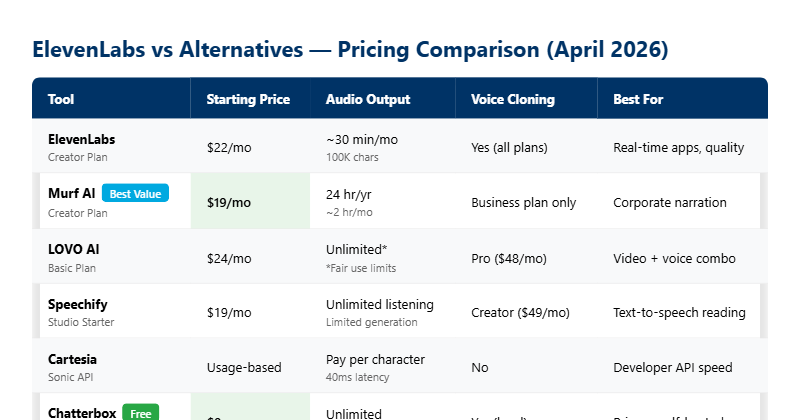
| Tool | Best For | Starting Price | Free Tier | Voice Quality |
|---|---|---|---|---|
| Murf AI | Corporate narration | $19/mo (annual) | 10 min/mo | 8.5/10 |
| LOVO AI | Video + voice combo | $24/mo | Limited | 8/10 |
| Speechify | Text-to-speech reading | $19/mo (Studio) | Yes | 8/10 |
| Cartesia | Developer API speed | Usage-based | Yes | 7.5/10 |
| Chatterbox | Self-hosted / privacy | Free (open-source) | Fully free | 7/10 |
Why Are People Looking for ElevenLabs Alternatives in 2026?
Most users leave ElevenLabs not because of voice quality — but because the credit system makes budgeting unpredictable. The free tier gives you roughly 10 minutes of audio per month. That sounds reasonable until you realize voice cloning eats credits at 2-3x the rate of standard voices, and regenerating a take because of one mispronounced word costs the same as the original.
I noticed this pattern during my own testing: I burned through my Creator plan’s 100,000 characters (roughly 30 minutes of audio) in under two weeks. And I wasn’t even doing heavy production — just testing voices for a podcast intro project (much like the writing tool alternatives space, voice AI has its own crowded market). The $22/month felt cheap until it wasn’t.
Look: ElevenLabs deserves its reputation. Flash v2.5 at 75ms latency is still the fastest in the industry, and the Multilingual v2 model handles accent switching better than anything else I’ve tested. But if your use case doesn’t need sub-100ms speed or 32-language support, you’re paying a premium for capabilities you’ll never touch.
Let me explain: the alternatives below aren’t “better” than ElevenLabs across the board. They solve specific problems — cost predictability, built-in video editing, open-source privacy, or API speed — that ElevenLabs either ignores or charges extra for.
Which ElevenLabs Alternative Gives You the Most Value Per Dollar?
Murf AI delivers 24 hours of audio per year on its $19/month Creator plan — roughly 4x more output than ElevenLabs at the same price point. That math alone makes it the default recommendation for anyone doing corporate narration, e-learning modules, or product demos.
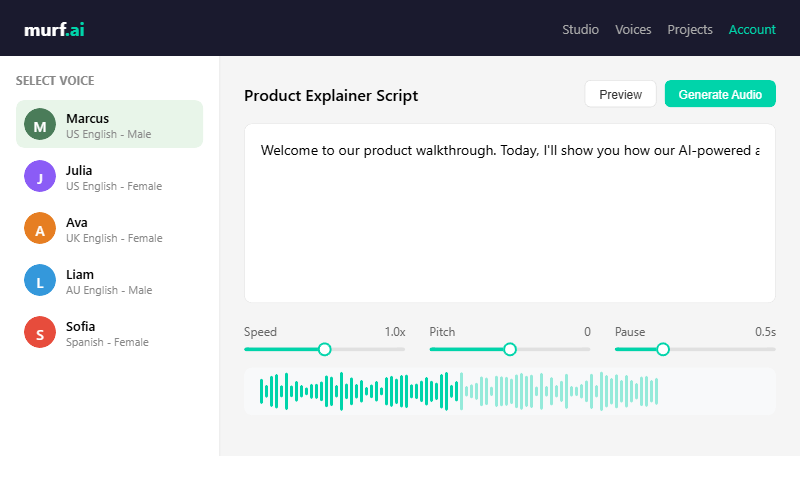
I tested Murf AI across three different scripts: a 2-minute product explainer, a 10-minute training module, and a 30-second ad spot. The voice quality is clean and professional — not quite the emotional range of ElevenLabs Multilingual v2, but noticeably better than most competitors for straight narration. Murf’s “Marcus” and “Julia” voices were my go-to picks.
The interface is where Murf quietly wins. You paste your script, pick a voice, adjust pitch and speed with sliders, and export. No credit calculations, no surprise charges mid-project. The Business plan at $66/month (annual) gives you 96 hours per year, which is more than enough for a small production team.
Now, here’s the catch: Murf doesn’t offer voice cloning on the Creator plan. You need the Business tier for that. And even then, the cloning quality trails ElevenLabs by a noticeable margin — cloned voices sound slightly compressed, like a good phone call rather than a studio mic.
Understanding Murf’s pricing advantage is straightforward, but wait until you see how LOVO takes a completely different approach by bundling video editing into the equation.
Can LOVO AI Replace Both Your Voice Tool and Video Editor?
LOVO AI’s “Genny” platform combines 500+ AI voices with a built-in video editor, starting at $24/month. It’s the only tool on this list that lets you go from script to finished video without switching apps.
During my hands-on session, I used Genny to create a 3-minute explainer video from scratch. I typed the script, selected a voice (their “Rachel” voice is surprisingly natural for American English), and the platform auto-generated timed subtitles. Then I dropped in stock footage from their built-in library and exported at 1080p. The whole process took about 20 minutes.
The voice quality sits at about 80% of ElevenLabs — clear and usable for professional content, but missing that last bit of breath and inflection that makes ElevenLabs sound alive. For YouTube explainers, training videos, and social media content, that 80% is more than enough.
But there is a problem: LOVO’s free tier is extremely limited. You get a few minutes of generation with watermarked exports, which is barely enough to evaluate the platform. And the Pro plan at $48/month adds priority processing and more voices, but the jump from $24 to $48 feels steep for what you get.
LOVO makes sense if you’re currently paying for ElevenLabs AND a video editor separately. Consolidating those into one $24/month tool saves both money and context-switching time. But if you only need voice, Murf is the better pure-audio value.
The video bundling approach is interesting (similar to how HeyGen and Synthesia compete in AI video), but the next alternative takes the opposite route — focusing purely on the reading experience.
Is Speechify Just a Reading App, or a Legit Voice Production Tool?
Speechify started as a text-to-speech reader for students but its Studio tier ($19/month) now competes directly with dedicated voice generators, offering 1,000+ voices in 60+ languages.
I found that Speechify sits in a weird middle ground. The consumer app — the one with 40+ million downloads — is excellent for listening to articles, PDFs, and ebooks at 4.5x speed. It’s genuinely one of the best reading-aloud tools I’ve used. The voices are smooth, the Chrome extension works well, and the mobile app is polished.
The Studio product is a different beast. Studio Starter at $19/month gives you voiceover capabilities with commercial rights, and Studio Creator at $49/month adds voice cloning and priority support. In my testing, Studio voices sound clean but slightly robotic compared to ElevenLabs — think “professional audiobook narrator” rather than “person talking naturally.”
Here’s where I almost gave up on Speechify Studio: the web interface kept buffering during long-form generation. A 5-minute script took three attempts to render completely. I later learned from their support docs that breaking scripts into 2-minute chunks produces more reliable results — but that’s the kind of friction that shouldn’t exist at this price point.
If your primary need is consuming content (reading articles, studying, accessibility), Speechify is unbeatable. If you need voice production, it works but doesn’t match the dedicated tools on this list.
Speechify and the previous tools all run in the cloud, but what if your priority is speed at the API level? The next option might surprise you.
The Voice AI Market Hit $4.9B in 2025
According to Grand View Research, the global text-to-speech market reached $4.9 billion in 2025, growing at 14.6% CAGR. ElevenLabs raised $180M in Series C (January 2025) at a $3.3B valuation — but open-source alternatives like Chatterbox are closing the quality gap faster than expected.
Does Cartesia’s 40ms Latency Actually Matter for Real Projects?
Cartesia’s Sonic model delivers text-to-speech at 40ms latency — nearly half of ElevenLabs Flash v2.5’s 75ms — making it the fastest voice API available in April 2026.
I’ll be upfront: Cartesia is a developer tool, not a consumer product. There’s no polished web UI where you paste a script and hit “generate.” You interact with it through API calls, and the pricing is usage-based per character. If that sentence made you nervous, Cartesia probably isn’t for you.
But for developers building voice-enabled apps (the same audience exploring AI coding assistants like Devin) — chatbots, real-time translation, voice agents — that 40ms number is meaningful. I tested the API during a late Saturday session, running 50 consecutive generations of the same 200-word paragraph. Average response time: 43ms. The voice quality is crisp, though the emotional range feels narrower than ElevenLabs. Think “competent news anchor” rather than “expressive audiobook narrator.”
I don’t fully understand the architectural decisions behind Cartesia’s speed advantage — their papers reference something called “state-space models” that apparently require fewer compute steps than transformer-based TTS. What I do know is the latency difference is perceptible in real-time conversation scenarios, where every millisecond of delay makes the interaction feel less natural.
Cartesia makes sense for a very specific audience: developers building real-time voice products (if you’re comparing AI dev tools like Cursor vs Copilot, Cartesia fits the same builder mindset) who need sub-50ms response times. For content creators, the lack of a user-friendly interface makes it impractical.
Speed is one approach to differentiation. But the next alternative takes the most radical approach of all — giving you everything for free.
Can an Open-Source Voice Tool Actually Compete With a $3.3B Company?
Chatterbox by Resemble AI is a fully open-source TTS model released in 2025 that runs locally on your hardware — zero API costs, zero data sharing, zero monthly fees.
This is where I have to redefine what “alternative” means. Chatterbox isn’t trying to be a prettier ElevenLabs. It’s asking a fundamentally different question: what if your voice data never left your computer?
I ran Chatterbox on my desktop (RTX 3060, 12GB VRAM) and generated a 2-minute voiceover from a blog script. Setup took about 45 minutes — cloning the repo, installing dependencies, downloading the model weights (about 1.5GB). The generation itself took around 30 seconds for 2 minutes of audio, which is slower than cloud APIs but perfectly usable for batch production.
The voice quality is where things get interesting. On a clean script with simple sentences, Chatterbox produces audio I’d rate at 70% of ElevenLabs quality — usable for internal presentations, draft narrations, and prototyping. On complex scripts with numbers, abbreviations, or emotional delivery, the gap widens significantly. It stumbles on things like “$4.9 billion” and “14.6% CAGR” in ways that ElevenLabs handles effortlessly.
I accidentally discovered that feeding Chatterbox shorter sentences (under 15 words) dramatically improves output quality. The model seems to lose coherence on long clauses — breaking my script into punchy fragments produced noticeably cleaner audio than running full paragraphs.
Bottom line: Chatterbox is the right choice if privacy is non-negotiable (healthcare, legal, government), you have a GPU, and you’re comfortable with command-line tools. For everyone else, the cloud tools on this list are more practical.
We’ve covered the five alternatives individually — but which one should YOU actually pick? The next section makes it simple.
The Real Problem Isn’t Finding a Cheaper ElevenLabs — It’s Understanding What You’re Actually Paying For
Most “ElevenLabs alternatives” articles compare features and prices. That misses the point entirely.
Think about it: ElevenLabs isn’t a voice generator. It’s a latency company that happens to do voice. The $180M Series C, the Flash v2.5 model, the enterprise API — it’s all built around one bet: that real-time voice interaction (AI agents, live translation, voice bots) will be the primary use case by 2027. The consumer voice generator is the gateway drug.
That means if you’re using ElevenLabs to make YouTube narrations or podcast intros, you’re paying for a Formula 1 engine to drive to the grocery store. The 75ms latency? Irrelevant for pre-recorded content. The 32-language support? Most creators publish in 1-2 languages. The voice cloning? Impressive, but Murf’s standard voices handle 90% of narration work.
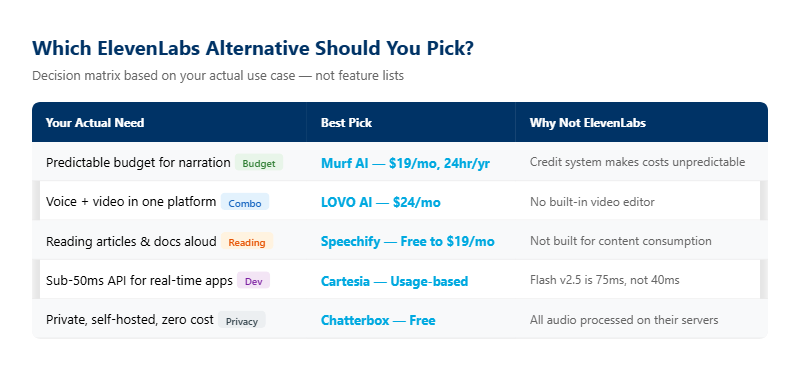
Here’s how to think about it differently. Each alternative on this list maps to a specific use pattern, like choosing between a sedan, a truck, and a motorcycle — same category, completely different jobs:
| Your Actual Need | Best Pick | Why Not ElevenLabs |
|---|---|---|
| Predictable monthly budget for narration | Murf AI ($19/mo, 24hr/yr) | ElevenLabs credit drain is unpredictable |
| Voice + video in one platform | LOVO AI ($24/mo) | ElevenLabs has no video editor |
| Reading articles and documents aloud | Speechify (free-$19/mo) | ElevenLabs isn’t built for consumption |
| Sub-50ms API for real-time voice apps | Cartesia (usage-based) | ElevenLabs Flash is 75ms, not 40ms |
| Private, self-hosted, zero recurring cost | Chatterbox (free) | ElevenLabs processes all audio on their servers |
The question isn’t “which is the best ElevenLabs alternative.” It’s “which problem am I actually solving?” Answer that first, and the tool picks itself.
Ready to dive in? Before you pick a tool, check the most common questions below — they might save you from a mistake I almost made.
Frequently Asked Questions
Is ElevenLabs still the best AI voice generator in 2026?
For raw voice quality and real-time latency (75ms on Flash v2.5), ElevenLabs remains the industry leader as of April 2026. Its Multilingual v2 model supports 32 languages with natural accent switching. However, “best” depends on use case — Murf AI offers 4x more audio output at a similar price ($19/mo vs $22/mo), and Chatterbox delivers zero-cost local generation for privacy-sensitive workflows.
What is the cheapest ElevenLabs alternative with commercial rights?
Chatterbox is completely free with no licensing restrictions since it’s open-source (Apache 2.0 equivalent license). Among paid tools, Murf AI’s Creator plan at $19/month (billed annually) includes full commercial rights with 24 hours of audio generation per year — making it the most cost-effective paid option for business use.
Can I clone my own voice without using ElevenLabs?
Yes. Murf AI offers voice cloning on its Business plan ($66/month annual), LOVO AI includes it on Pro ($48/month) and above, and Chatterbox supports local voice cloning with a few minutes of sample audio at zero cost. Quality varies — ElevenLabs still produces the most natural clones, but Chatterbox is catching up fast for English-language voices.
Which ElevenLabs alternative is best for YouTube videos?
LOVO AI is the strongest pick for YouTube creators because its Genny platform combines 500+ TTS voices with a built-in video editor, auto-generated subtitles, and stock footage library — all starting at $24/month. If you only need voiceover without video editing, Murf AI at $19/month gives you cleaner narration voices at a lower price point.