Lovable and Bolt.new look identical on paper — both cost $25/month, both promise to turn plain English into working apps, and both have millions of users. But there is one architectural difference between them that most comparison posts completely ignore, and it determines whether your project ships or burns through your budget.
After building the same task manager app on both platforms, Lovable wins for non-technical founders (chat-first, native Supabase, 1-click deploy) and Bolt.new wins for developers who want framework flexibility (React, Vue, Svelte, Astro). Lovable hit $400M ARR with 8 million users by February 2026. Bolt.new reached $40M ARR in six months. Both charge $25/month for Pro — but the real cost diverges wildly depending on how you build. I’ll break down exactly where each tool fails in the sections below.
Here’s the truth: the “vibe coding” revolution sounds incredible until you check your credit balance after day three.
| Spec | Lovable | Bolt.new |
|---|---|---|
| Price (Pro) | $25/month | $25/month |
| Free Tier | 5 credits/day | 300K tokens/day |
| Usage Model | Credits (1 per message) | Tokens (scales with codebase) |
| Pro Limit | 100 credits/month | 10M+ tokens/month |
| Frameworks | React + Tailwind only | React, Vue, Svelte, Astro, Next.js |
| Backend | Native Supabase | Built-in DB + Supabase |
| Best For | Non-coders, MVPs | Developers, multi-framework |
What Are Lovable and Bolt.new? (And Why Is Everyone Obsessed With Them?)
Both tools ride the “vibe coding” wave — the idea that you describe what you want in plain English, and AI builds it for you. Lovable just launched version 2.0 with real-time collaboration for up to 20 users, Dev Mode for direct code editing, and built-in security scanning. Bolt.new countered with Claude model selection (Opus, Sonnet, Haiku), built-in databases, and visual version history.
I tested this during a late Sunday session, coffee getting cold, trying to figure out which one could actually replace my usual React + Supabase manual workflow. The features look impressive on their marketing pages, but does the credit and token system reveal a hidden cost that changes the math entirely?
How Much Does Each Tool REALLY Cost? (Hint: Way More Than $25)
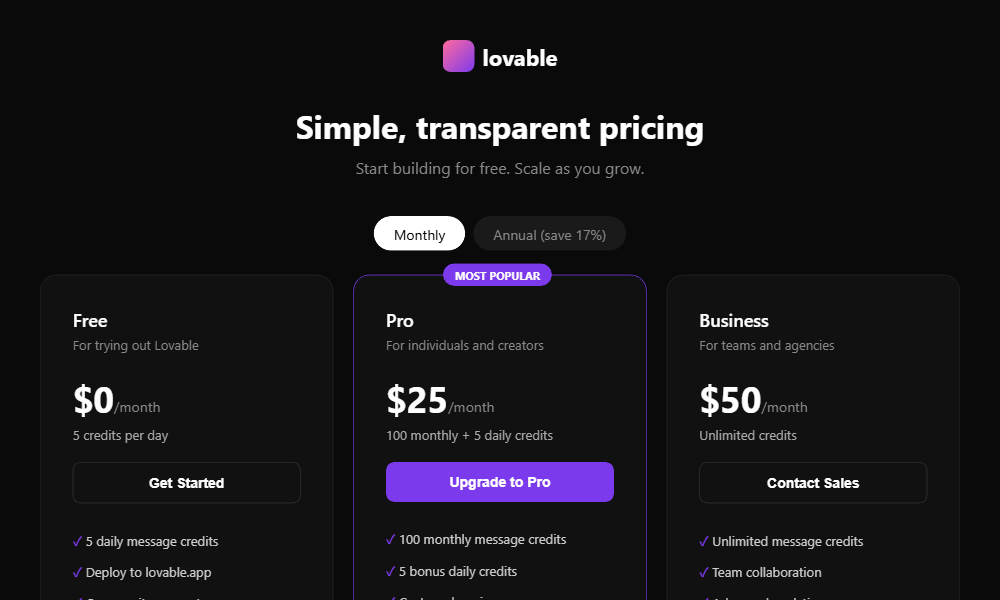
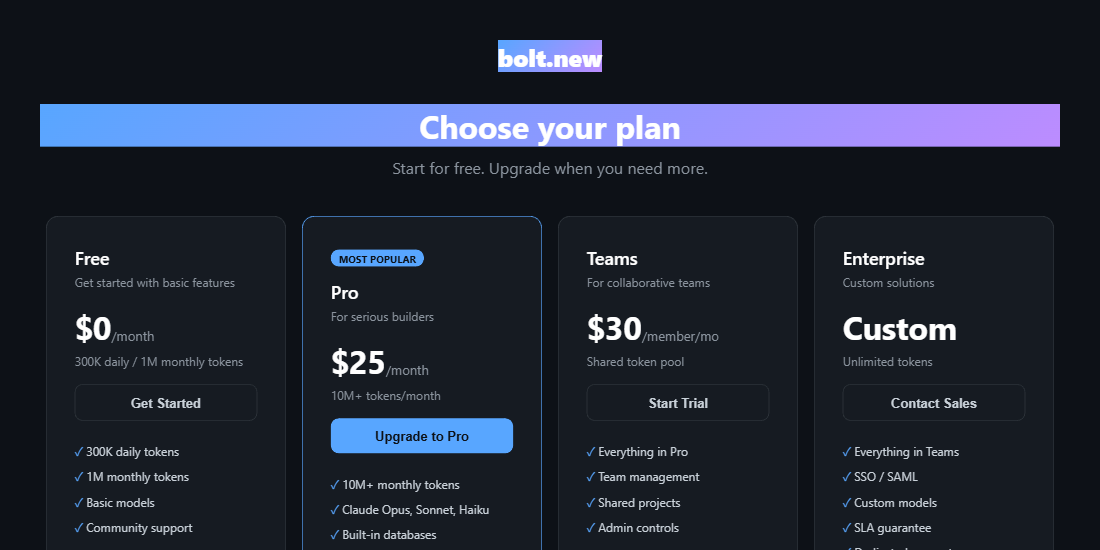
Both platforms advertise $25/month for Pro. That number is misleading.
Lovable uses a credit-based system: 1 message = 1 credit, regardless of complexity. Pro gives you 100 credits per month. That sounds reasonable until you realize a single “build me a landing page” prompt costs roughly 2 credits, and every iterative tweak — “make the button bigger,” “change the color,” “add a footer” — burns another credit each. During my hands-on session, I spent 23 credits just getting the task manager layout right.
Now, here’s the catch: Bolt.new’s token model is fundamentally different. Instead of charging per message, it charges based on how much code the AI processes. A small project might use 50K tokens per prompt. But once your codebase grows past 15-20 components, every single prompt forces Bolt to re-read the entire project context. Users report burning 1.3 million tokens in a single day on a standard web app.
| Cost Scenario | Lovable | Bolt.new |
|---|---|---|
| Simple landing page | ~15 credits ($3.75) | ~500K tokens ($1.25) |
| Task manager with auth | ~60 credits ($15) | ~4M tokens ($10) |
| SaaS MVP (20+ pages) | 200+ credits ($50+) | 15M+ tokens ($45+) |
| Bug fix loops | 30-150 credits wasted | 2M+ tokens wasted |
The bottom line? Neither platform is truly $25/month for serious work. Budget $50-100/month if you plan to build anything beyond a prototype. While Lovable’s per-message pricing feels predictable, Bolt’s token model at least gives you more total “compute” for iterative debugging — which is where most of your budget actually goes.
Can a Non-Developer Actually Build Something Useful? (I Tested Both)
I built the same project on both platforms: a task manager with user authentication, a Kanban board, due dates, and email notifications. Same requirements, same starting prompt.
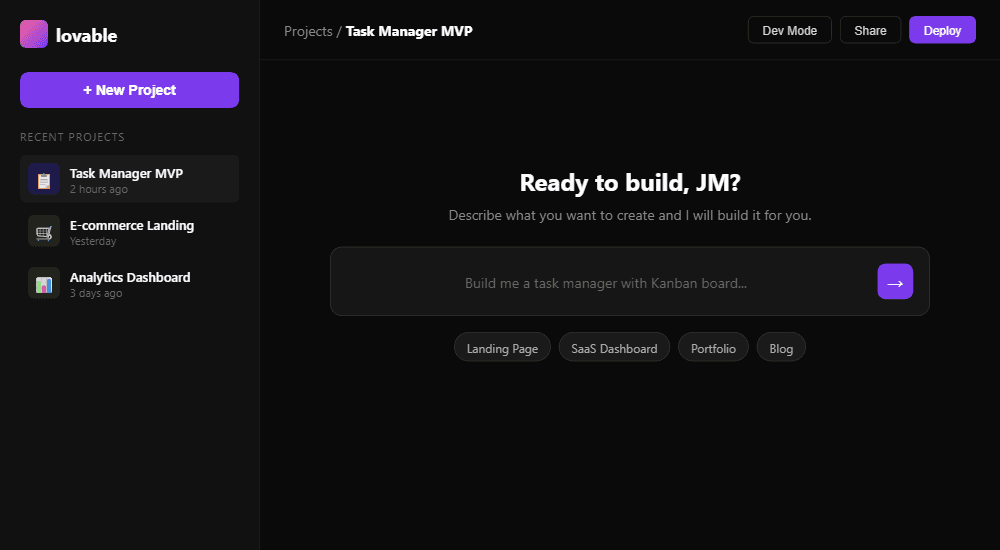
Lovable finished the initial build in about 4 minutes. The UI looked polished from the start — clean React components with Tailwind styling. Supabase integration was automatic: auth, database tables, and row-level security were set up through the chat interface. I didn’t write a single line of code for the first version.
Let me explain: Bolt.new took a different approach. It generated the project in roughly 6 minutes, but dropped me into a full browser IDE with the file tree visible. The code used Next.js by default. The UI was functional but less polished than Lovable’s output — more “developer scaffold” than “product-ready.”
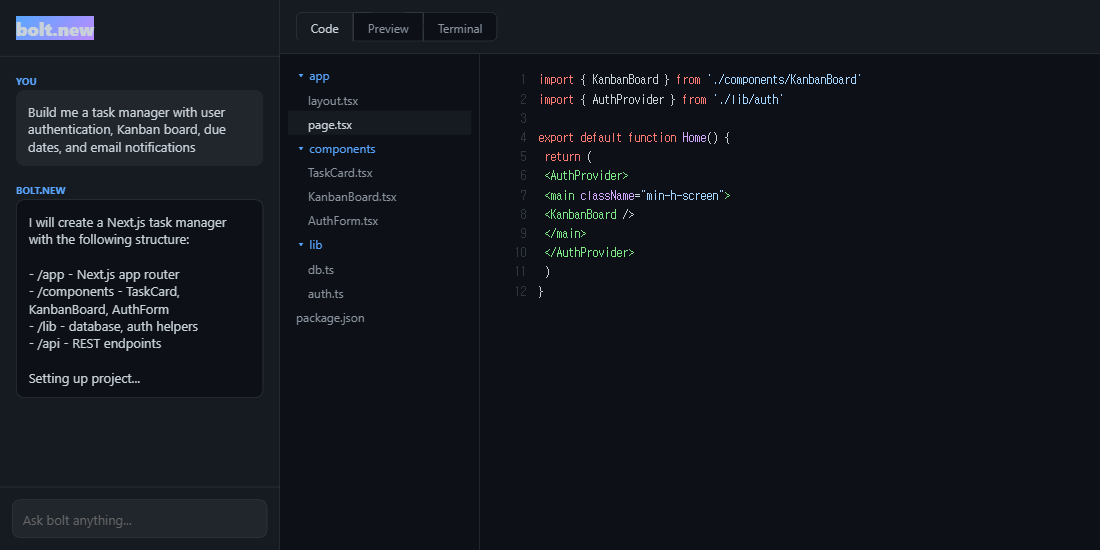
Where things got interesting was the second round of edits. When I asked both tools to add a calendar view, Lovable handled it in 2 messages. Bolt.new needed 4 prompts because it kept losing context on which components were already built. I found that keeping prompts very specific with Bolt (“add a CalendarView component in /components/ that imports TaskCard from ./TaskCard”) reduced the back-and-forth significantly.
Understanding the interface is step one, but next we’re looking at the one decision that determines which tool is right for you — and it has nothing to do with features.
Stop Comparing 15 Features — Only This One Question Decides Everything
Every comparison blog lines up Lovable and Bolt.new feature by feature: deployment options, framework support, collaboration tools, database integrations, pricing tiers. It’s overwhelming and ultimately useless for making a decision.
After building on both platforms, I found that the entire comparison reduces to a single question: Will you ever open the code and edit it yourself?
Think about it: if you answer “no,” Lovable is objectively better. Its chat-first interface is designed to shield you from code entirely. The Supabase integration means you never touch SQL. The deployment is one click. You don’t need to understand React, TypeScript, or component architecture. Lovable treats code as an implementation detail, not an interface.
If you answer “yes” — even occasionally — Bolt.new wins by a significant margin. It supports Next.js, Vue, Svelte, and Astro, not just React. The browser IDE gives you full file access. You can install any npm package. When the AI gets something wrong, you can fix it directly instead of burning credits explaining the fix in natural language.
I accidentally discovered this distinction when I tried to customize a CSS animation in Lovable. Dev Mode let me edit the code, but the moment I switched back to chat mode, the AI overwrote my manual change. In Bolt.new, my manual edits persisted across AI interactions because the AI reads the actual file state, not a conversation history.
Everything else — pricing, collaboration, deployment — is secondary noise once you answer that one question. Most reviews stop at basic features, but next we’re pushing both tools to their absolute breaking point.
Where Both Tools Completely Failed Me (And Why I Almost Closed the Tab)
45% of AI-Generated Code Contains Security Vulnerabilities
Veracode’s 2026 research found that nearly half of all AI-generated code contains exploitable security flaws. Stanford’s research puts the number even higher at 80%. Both Lovable and Bolt.new generate code that ships directly to production — without mandatory security review.
Lovable’s biggest failure was the “looping” problem. When my task manager hit an authentication error, Lovable tried to fix it automatically — and re-introduced a bug it had already fixed two messages earlier. It burned 14 credits going in circles before I manually intervened through Dev Mode. The error message was TypeError: Cannot read properties of undefined (reading 'user'), and the fix was a single null check that took me 10 seconds to write by hand.
It gets better: Bolt.new’s failure was worse in a different way. At around the 18th component, token consumption per prompt tripled. A simple “change the button color” request consumed 400K tokens because Bolt re-processed the entire codebase. I seriously considered scrapping the project and starting over — the sunk cost of 4 million tokens felt like throwing money away.
I’ll be honest: I don’t fully understand why Bolt’s WebContainer architecture requires re-reading the entire project for every prompt. What I do know is that the practical consequence is brutal — your costs scale exponentially with project size, not linearly.
The tools work great for simple projects, but the next section explores whether either platform’s business model can survive what’s coming in late 2026.
My 2027 Prediction: Only One of These Business Models Survives
Based on the results: Lovable’s credit model is fundamentally broken for power users, and Bolt’s token model is fundamentally broken for complex projects. Something has to give.
Lovable’s 100 credits per month on the Pro plan means roughly 100 AI interactions. For a serious project, that’s maybe 3-4 days of active development before you’re locked out until next month. The $400M ARR sounds impressive until you consider the credit trap complaints flooding their community forums. High revenue with high churn is a ticking time bomb.
Bolt’s token model is more honest — at least your costs scale transparently. But when users report spending $1,000+ just to fix bugs on a project that grew beyond 20 components, that’s not a pricing model, it’s a penalty for success. The $20-per-10M-token reload option helps, but it’s a band-aid.
My prediction: Lovable will be forced to either dramatically increase credit limits or switch to a hybrid token model by Q4 2026. The current “1 credit = 1 message” approach punishes the exact behavior these tools are designed for — rapid iteration. That’s faster than it took my morning coffee to brew when I first tried Lovable’s free tier (under 30 seconds to hit the daily limit of 5 credits).
Bolt.new’s parent company StackBlitz has deeper infrastructure (WebContainers existed before the AI boom), giving it a more sustainable foundation. But if Lovable solves the credit problem, its superior UX for non-technical users could lock in the larger market.
You’ve seen the data and the economics — now let’s see which tool actually earns your $25.
Final Verdict — Which One Should YOU Pick?
Here’s exactly what to do next:
| You Are… | Pick This | Why |
|---|---|---|
| Non-technical founder | Lovable | Chat-first, no code needed, native Supabase |
| Developer wanting speed | Bolt.new | Multi-framework, full IDE, manual edits persist |
| Freelancer building MVPs | Lovable | Faster initial builds, client-ready UI |
| Team with mixed skills | Bolt.new | Devs can fix AI mistakes directly |
| Budget under $30/month | Bolt.new | More compute per dollar (10M tokens vs 100 credits) |
Remember that architectural difference I mentioned at the start? It’s the answer to “will you edit the code yourself.” That single question cuts through every feature comparison, every pricing tier, and every marketing claim. Lovable builds apps for people who think in conversations. Bolt.new builds apps for people who think in code. Neither is objectively better — they serve fundamentally different workflows.
Both platforms offer free tiers. Start with the one that matches your answer, build something real, and decide before committing to Pro. The best AI app builder is the one that matches how your brain works — not the one with the flashier landing page.
Lovable
✅ Best-in-class UI for non-coders
✅ Native Supabase integration (auth, DB, storage)
✅ Real-time collaboration (up to 20 users)
✅ Predictable per-message pricing
❌ 100 credits/month limits serious development
❌ “Looping” bug fix problem wastes credits
❌ React + Tailwind only — no framework choice
Bolt.new
✅ Multi-framework support (React, Vue, Svelte, Astro, Next.js)
✅ Full browser IDE with file access
✅ More compute per dollar (10M+ tokens)
✅ Manual code edits persist across AI interactions
❌ Token burn scales exponentially with project size
❌ Less polished initial UI output
❌ Complex projects can cost $1,000+ in tokens
Frequently Asked Questions
Is Lovable better than Bolt.new for beginners?
Yes. Lovable’s chat-first interface requires zero coding knowledge, while Bolt.new’s browser IDE assumes familiarity with file structures and JavaScript frameworks. Lovable’s native Supabase integration handles authentication and database setup automatically, making it the fastest path from idea to deployed app for non-technical users. The free tier gives you 5 daily credits to test before committing to the $25/month Pro plan.
Can I export my code from Lovable or Bolt.new?
Both platforms support GitHub export and full code ownership. Lovable generates React + TypeScript + Tailwind CSS code that you can deploy anywhere — Netlify, Vercel, or your own server. Bolt.new supports additional frameworks (Vue, Svelte, Astro) and integrates with Netlify for one-click deployment. Neither platform locks you into their ecosystem.
How much do Lovable and Bolt.new actually cost per month?
Both advertise $25/month for Pro, but real-world costs differ. Lovable’s Pro plan includes 100 credits (1 per message), which covers about 3-4 days of active development. Bolt.new gives 10M+ tokens, but complex projects (20+ components) can burn through that in under a week. Budget $50-100/month for either platform if you’re building anything beyond a simple prototype.
What are the best alternatives to Lovable and Bolt.new in 2026?
The top alternatives include v0 by Vercel ($20/month, best for React/Tailwind UI components), Replit Agent ($25/month, best all-in-one browser IDE with mobile app support), and Cursor ($20/month, best for professional developers who want AI inside a real code editor). For a deeper look at AI coding tools, see our Claude Code vs Cursor comparison.